
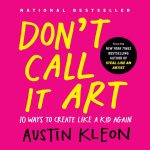
Feeling burnt out, distracted, and out of fresh ideas? In every creative person’s life, there are times when you lose the energy, joy, and freedom you had when you were first starting out. From the recent art school graduate to the retiree searching for their creative third act, we all need help returning to the excitement, the sense of discovery, and the raw creativity of a child at play. An immediate National Bestseller, Don’t Call It Art is a creative liberation handbook for looking at the world with fresh eyes, unlearning what you’ve learned, and making new leaps in your life and work.
Since his breakout New York Times bestseller Steal Like an Artist, Austin Kleon has been one of the world’s leading teachers of creativity. His books have sold nearly two million copies and translated into 30 languages. Now, in his most encouraging and inspiring book yet, Kleon shares ten rejuvenating lessons he learned from being a studio assistant to the artists closest to his heart: his two young sons. Kleon discovered that nurturing his kids taught him how to create the conditions under which his own – and everyone’s creativity – can thrive.
Illustrated in Kleon’s signature style of illustrations, quotes, stories and examples, Don’t Call It Art is a blast of creative energy that will give you permission to play, make a mess, and venture beyond your imagination – and ultimately, to feel the unbridled joy of creating in your own unique way.


 Jez Burrows opened the New Oxford American Dictionary and sat, mystified. Instead of the definition of “study” he was looking for, he found himself drawn to the strangely conspicuous, curiously melodramatic sentence that followed it: “He perched on the edge of the bed, a study in confusion and misery.” It read like a tiny piece of fiction on the lam and hiding out in the dictionary—and it wasn’t alone. Was it possible to reunite these fugitive fictions? To combine and remix example sentences to form new works? With this spark and a handful of stories shared online,
  In a very real sense we define our lives through our stories. Understand these stories, along with the motivations behind them, and we can positively change how our future unfolds. With this premise, Elle Luna, artist and author of The Crossroads of Should and Must, and psychotherapist Susie Herrick present
  A few common principles drive performance, regardless of the field or the task at hand. Whether someone is trying to qualify for the Olympics, break ground in mathematical theory or craft an artistic masterpiece, many of the practices that lead to great success are the same. In
  Of all the world’s great cities, perhaps none is so defined by its Art Deco architecture as New York. Lively and informative,
  An employee leaves and you post the open position. Resumes trickle in. You interview a few candidates. No one fits the bill. The next thing you know, three months have passed and that desk is still empty… Nothing drives business success like a staff of talented, productive employees. So why accept a hiring process that fails you time and time again? Well, there’s one person who doesn’t: Scott Wintrip. And in
  Deep within the American Dream lies the belief that hard work and steady saving will ensure a comfortable retirement and a better life for one’s children. But even for many families who seem to be doing everything right in an era of unprecedented prosperity, this ideal is still out of reach.
 In 2000, Keith Devlin — Stanford mathematician, author of 30+ popular math books, and NPR’s “Math Guy” — set out to research the life and legacy of the medieval mathematician Leonardo of Pisa, popularly known as Fibonacci, whose book Liber abbaci has quite literally affected the lives of everyone alive today. Although he is most famous for the Fibonacci numbers — which, it so happens, he didn’t invent — Fibonacci’s greatest contribution was as an expositor of mathematical ideas at a level ordinary people could understand. In 1202, Liber abbaci — the “Book of Calculation” — introduced modern arithmetic to the Western world. Yet Fibonacci was long forgotten after his death, and it was not until the 1960s that his true achievements were finally recognized.
 Is it possible both to be a conscientious citizen of the world and grow one’s own wealth? Jonathan DeYoe, the author of
  The decades after World War II were a golden age across much of the world. It was a time of economic miracles, an era when steady jobs were easy to find and families could see their living standards improving year after year. And then, around 1973, the good times vanished. The world economy slumped badly, then settled into the slow, erratic growth that had been the norm before the war. The result was an era of anxiety, uncertainty, and political extremism that we are still grappling with today.
 One of the earliest of all Buddhist texts, the Atthakavagga, or “Book of Eights,” is a remarkable document, not only because it comes from the earliest strain of the literature–before the Buddha, as the title suggests, came to be thought of as a “Buddhist”–but also because its approach to awakening is so simple and free of adherence to any kind of ideology. Instead the Atthakavagga points to a direct and simple approach for attaining peace without requiring the adherence to doctrine.
  Thousands of years ago, early humans had an innate need to communicate, but no written language. So they found an easy and natural way to share their thoughts and stories: pictures. Today, after so many years when speaking and writing grew dominant, we’re back in another highly visual age. About 90 percent of everything shared online is now visual – selfies, GIFs, smartphone videos, and more. To survive and thrive in this new visual era, it’s important to harness the power of imagery. You don’t need to be Leonardo da Vinci to be an outstanding visual thinker and communicator. The most effective drawings are the simplest, and you can get good at those in three minutes. In this clear, powerful little book,
  To survive in today’s gig economy, you have to be a mover, a shaker, a doer, and a maker.
  “Disruption” is a business buzzword that has gotten out of control. Today everything and everyone seem to be characterized as disruptive. Now in
  No aspect of the Buddha’s teaching seems to have been more misunderstood and neglected than Right Concentration, yet it is a part of the Noble Eightfold Path and an integral element of the Buddha’s own path to awakening. Now legendary American Buddhist teacher Leigh Brasington’s
  From the New York Times bestselling author of Steal Like an Artist and Show Your Work! comes an interactive journal and all-in-one logbook to get your creative juices flowing and keep a record of your ideas and discoveries.


 Innovators today are told to run loose and think lean in order to fail fast and succeed sooner. But in a world obsessed with the new, where cool added features often trump actual customer needs, it’s the consumer who suffers. In our quest to be more agile, we end up creating products that underwhelm. Today’s leading companies understand that emotional connection is critical to product development. And they use a clear, repeatable design process that focuses squarely on consumer engagement rather than piling on features for features’ sake. In Well-Designed: How to Use Empathy to Create Products People Love, a refreshingly jargon-free and practical book, product design expert

 For many financial professionals as well as individual investors, behavioral bias is the largest single factor behind poor investment decisions. The same instincts that our brains employ to keep us alive all too often work against us in the world of finance and investments. Investing Psychology: The Effects of Behavioral Finance on Investment Choice and Bias, by noted finance expert
 In his New York Times bestseller Steal Like an Artist,
  The Doodle Revolution: Unlock the Power to Think Differently is a fearless guide to awakening your mind using simple visual language. What do Einstein, Edison, Richard Feynman, Henry Ford, and JFK have in common? Like virtually all heavy-hitting thinkers, they looked beyond just words and numbers to get intellectual and creative insights. They actively applied a deceptively simple tool to think both smarter and faster: the doodle. And so can the rest of us-zero artistic talent required. Visual thinking expert


 Ancient Wisdom, Modern Kitchen: Recipes from the East for Health, Healing, and Long Life, a winner in the 2010 International Book Awards, reveals how easy it is to tap into the 3,000-year-old secrets of the Eastern healing arts. This entertaining and easy-to-use book provides scores of delicious recipes, anecdotes about various herbs and foods, and all you need to know about acquiring ingredients–even if you don’t know the difference between a lotus seed and the lotus position. Highlighting “superfoods” such as goji berries, as well as more familiar ingredients like ginger, garlic, and mint, it includes an overview of traditional Chinese medicine, herbs and food therapy, details on 100 healthy Asian ingredients, and recipes for a wide range of common health concerns, including fatigue, menopause, high cholesterol, weight control, and diabetes. Publishers Weekly says “the three authors of this well-penned title highlight key concepts of east Asian herbal cooking, and lucidly explain their holistic approach to cooking.” (Da Capo Press/Perseus)

 Visual thinking guru


